This is just a quick update on what I've been working on and my thoughts on the current job market.
The Death of Cold Apps
I'm making it official: cold applications are dead. Between talking to friends, reading market reports, and just feeling the general sentiment, the ROI on "spray and pray" has hit zero. After hundreds of applications I've gotten only a single interview, and you know what they say: the definition of insanity is doing the same thing and expecting different results. I'm still going to send out cold apps, but not too many, just so I have some way to know if things change, and also to keep in touch with the market (what skills are employers looking for, what companies are hiring, and what roles are they looking for).
While not common, I know people who have landed jobs with cold apps, so clearly it's possible. What I realized though is that these people were getting interviews, and it was just a matter of time before they passed them. So what's the difference between me and them? I can't know for sure, but it's likely just a resume diff. These people either have an Ivy League education, internships, or some sort of impressive undergrad experience that I simply don't have. At first I thought I was the only one, but after spending more time talking to others in my shoes I realize that I'm not, but on LinkedIn you only really pay attention to the people who already have jobs or who have a stacked background already.
Cold applications can still work, but if there's one thing I've learned after a year of looking for a job, its that most people get their job through connections, and networking is everything. You know what they say, your network is your net worth.
My Current Strategy
I think in this type of environment you have to be very experimental with your approach, and constantly be changing what you do to see what works, and what doesn't. There isn't really a playbook, so this is the best way to approach things in my opinion.
Currently I'm shifting my energy towards networking, appealing to recruiters, and targeting companies that are more likely to have jobs that require US Citizenship/the ability to obtain a security clearance (a smaller, less saturated pool). I'm pretty confident that the networking strategy is the right move, but I'll have to see if changing my target companies will make any difference.
My current networking strategy is going to a company's people page and connecting with a few people prioritizing by how likely they would be to accept my request and their relevance to the role I'm interested in. I will prioritize people that went to the same school as me or people that have mutual connections. I will sometimes even reach out to our mutual connection and see if they would be open to introducing us. I have to do this because LinkedIn Premium only gives 5 InMail credits per month, so I have to use them conservatively and save them for only the highest value connections.
I'm not asking anyone for a job. I'm just trying to get in front of people, and put myself in their minds. All I ask for is just a quick informational interview with people I reach out to. There are a lot of benefits that can come out of connections, including learning more about a role/company you're interested in, getting hiring or industry insights that can allow you to strategize better, being introduced to more people, or getting referrals. If you are fresh in someone's mind, maybe they hear about an opportunity and let you know about it. Just this week someone I reached out to for completely unrelated reasons connected me with someone he knew who is starting an AI company and looking to hire. I'm hoping that one of these random connections may be what ultimately lands me a job.
Finally, I optimized my LinkedIn profile with the intention of appealing to recruiters. What I'm starting to realize is that this is a much more effective strategy than spamming cold apps. This suspicion was confirmed when I talked to a friend who works as a Founding Engineer and is involved in the hiring process, and said that most of the people they hire are people their recruiters found, not people who cold applied. This aligns with my own personal experience: of the few interviews I have gotten, almost all of them came from a recruiter reaching out to me. That's really what put the nail in the coffin of cold apps for me.
Builder's Dilemma
I'm still working on LinkUp, my social app for university students. I recently sent out a user survey that confirmed my fears: people are hesitant to post because they feel awkward being the first one to make a post, are unsure how many others are on the app and if someone would even join, and don't know what to post. In a nutshell, there is substantial friction in making a post. This is why I recently made an update to the app, adding things like "quick buttons" to the feed, that make it easy to know how you can use the app and make it quick to make a post. I also streamlined the post process to make it feel smoother. Here's a couple of screenshots to give you an idea:
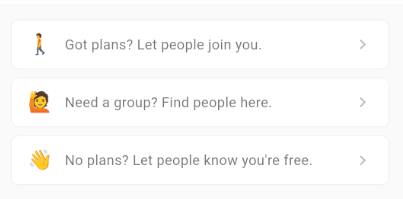
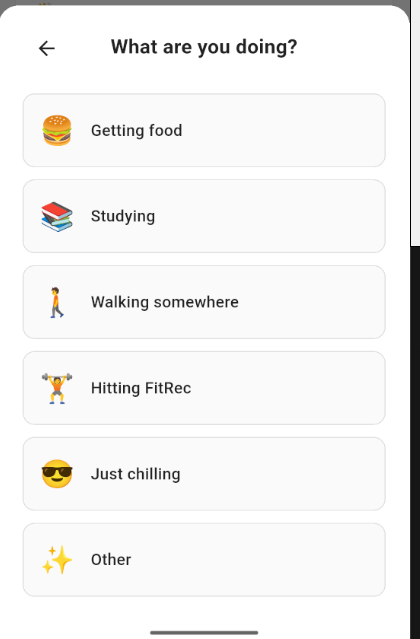
However, I'm also facing the fact that I chose a difficult market to enter if my goal is eventually making money. While I have ideas, there is no clear path to monetization, there is no market validation, and the app requires high user density to be valuable. In short, its a very risky idea that I can't be sure will lead anywhere.
This brings me to a new pursuit. I'm looking to assemble a group of 4 people to build a different SaaS product. This time, instead of just building something that I find interesting or cool, my primary goal will be to maximize the chances of making money, and minimize risk. I will enter a validated market then identify a solution that will take no longer than a few months to build, and in some way meaningful but simple way differentiates itself from other players. This could be something as simple as being cheaper, better design, better UX, or just making it simpler and trimming the fat off of an existing product. Working with a team will be a good learning experience, will allow us to move faster, and having multiple perspectives will increase the quality of our ideas. Even if it doesn't pan out, I know I will learn a lot, and since I'm setting a time constraint I know it won't waste too much time.
Finding Direction
While I have more direction than I did when I started this journey, it's still something I struggle with. Sometimes it feels like my brain is a RL model that isn't receiving any rewards, so it gets stuck in "exploration" mode rather than "exploitation". I constantly feel the pull to learn some new random skill, or learn about a new company, or a new role, instead of just taking the time to focus on one thing at a time. However, I'm learning to differentiate Signal vs. Noise. Just because I could learn Rust right now doesn't mean I should. I'm choosing to focus on the SaaS project and the job hunt.
The "Cooked" CS Grad Community
I'm starting to notice that I'm not alone in this. There is a growing demographic of people in my shoes, "Cooked" CS Grads if you will (not necessarily restricted to CS). We are talented, we are ambitious, but the market is brutal. I'm finding a lot of solace in hearing other people's stories, and I know others are as well. If there isn't one already, I want to build a community for people in our shoes. I think the main benefits are being able to vent and provide emotional support, to make connections which as I've mentioned are critical in the job search process, and to share advice and insights. I think we can learn a lot from each other. I'm thinking of making a Discord server for this community, and seeing if anyone else is interested.